The problem
Every warehouse and transport operation wants its own numbers on its own screen. Live, not in yesterday's spreadsheet.
Build a separate dashboard for each company and you get separate code, separate fixes and separate things to go wrong. Share one dashboard between companies and it's worse: one customer asks for a change and everyone's screen moves.
Transport adds its own pressure. On a trunking network, a late trunk is a problem for everyone downstream, and the earlier it's seen the better.
What I built
askadash: a multi-tenant KPI dashboard platform for warehouses and transport, designed and built by me and running on my own servers and AI infrastructure.
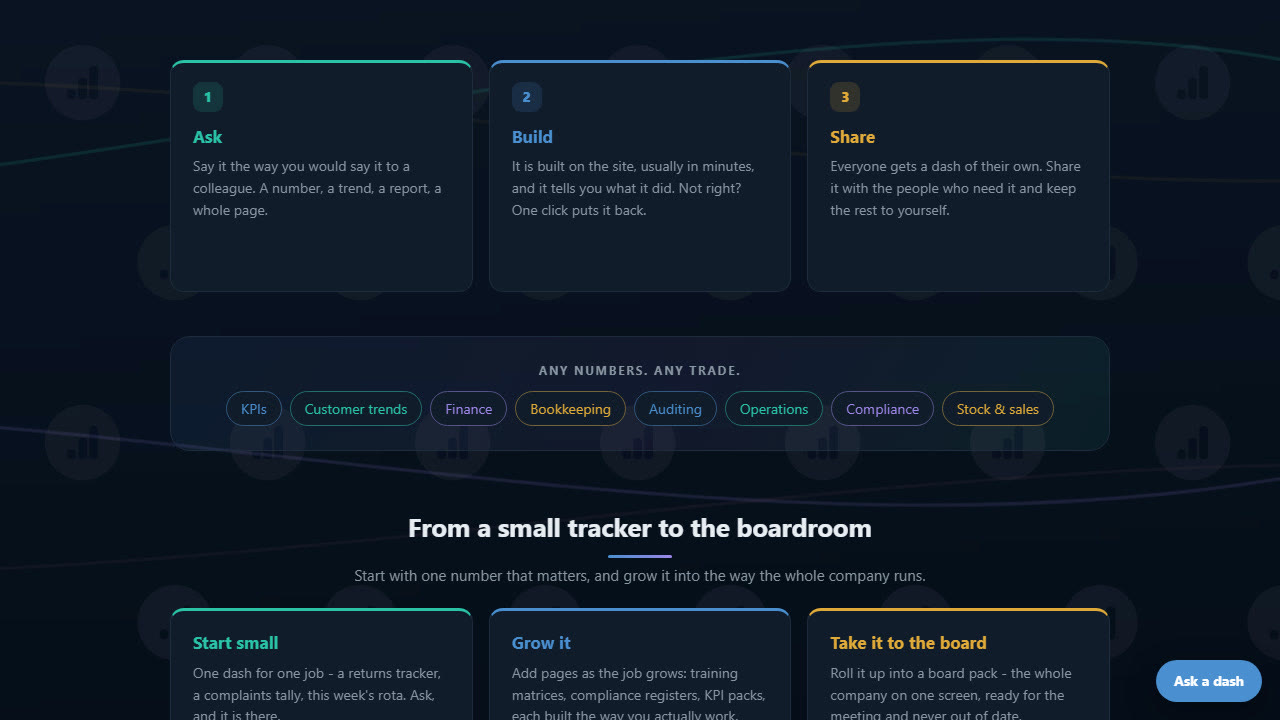
- Ask it, build it: say what you want to see, in your own words, and it is built on that company's own dash from its own numbers, usually in minutes. People check it, and one click puts it back.
- Each company has its own subdomain, with HTTPS set up automatically.
- Live KPIs for warehouse and transport operations.
- A late-trunk checker for a trunking network, so late trunks are visible on the screen.
- AI screens, with AI settings for each screen and a per-company override.
- Nightly backups.
And one rule above all the others: one company's change never touches another's. A request from one customer is built for that customer. Shared code stays shared, and stays stable.
How it runs now
Companies sit side by side on the same platform, each on its own address, each with its own screens. Adding a company means a new subdomain, not a new system.
When a company wants something changed, it's changed for them. Nobody else wakes up to a dashboard they didn't ask for.
The AI screens follow the same rule. Each screen has its own AI settings, and a company can override them for itself without changing anyone else's.
And every night the platform is backed up, without anyone having to remember to do it.
See it for yourself at askadash.com.